
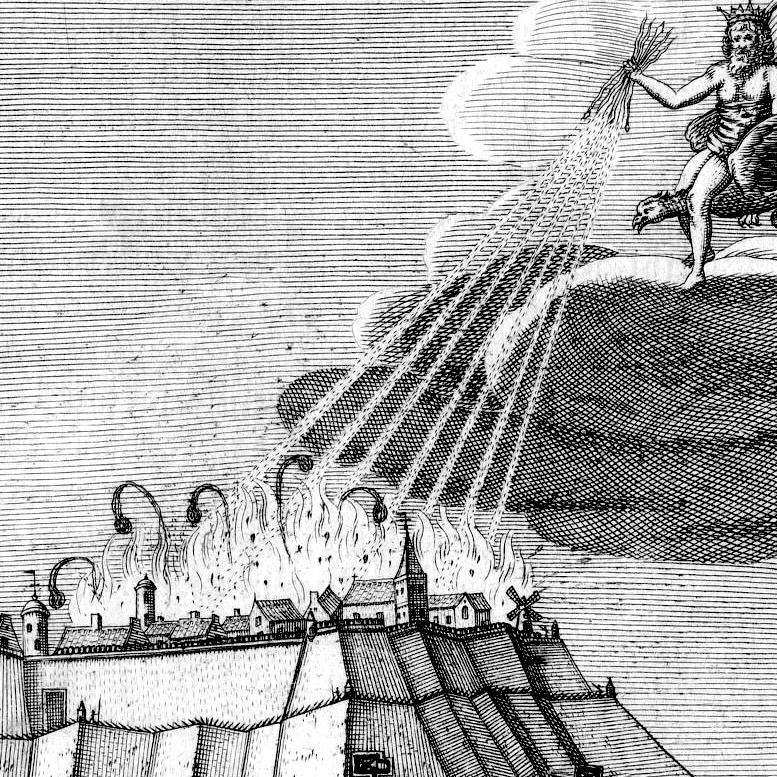
The Sealing created the Age of the Maker, leading to the visions of the prophet Lucia and the inauguration of the Collectio Aurea, the Church’s holy scriptures. But with the magical devastation of the Battle of Altun Plain and the destruction of two of His archons, the weakening known by the Collegia and Inquisition as the Sundering, is slowly letting the old gods back in.
The Maker
According to Liber Plasmogensis, the Maker was the Creator of All and to protect mortals from corruption and chaos, He sacrificed two-thirds of His blood, sealing away great demon princes in the Void, however rendering Himself in a divine repose that will last 2000 years. He is the Architect of the World; the Wounded God who asks His faithful to order the world and sacrifice as He did for the good of all.
Or He is a paranoid usurper who got what was coming to Him just as His seal was closing? Perhaps in His divine, semi-comatose state, He isn’t as omniscient as He claims, and 16 centuries of interpretation of His inscrutable revelations are merely futile rationalizations of divine fever dreams? Or perhaps it is something in between.
The Mother
According to the heretical texts kept by Her followers, She was the Maker’s consort and co-creator. He fashioned the stars and heavens and the planet, but She created life. But life being messy and beautiful was eventually too much for Him and He betrayed Her. They say She nearly destroyed Him, in the final act of Sealing Her away from Her children. So in the Void, She pines, laments, and seethes with absolute and unbounded fury.
She is a loving Mother, but sometimes a controlling Mother, and other times a terrifying force that will stop at nothing until the treasonous demiurge is annihilated and ever stone of His churches are dashed to the ground.
The Maiden
Ancient legends would keep returning to a particular and wholly peculiar motif: a goddess of life and love and beauty, but one bathed in blood and battle. One covered in flowers, but chthonic and hard to place. The virgin war goddess. The dawn and dusk.
These are reflections on the Maiden. She welcomes births and spring and love, but is also the whispered companion of the soldier knowing he will die that day, so he should best make it glorious.
She is the goddess of transitions and renewal. The mother of the fae and opener of doorways.
The Tyrant
It is all to easy to see Him for his worst aspects: blood, domination, violence. But He has long been known as a God of Promises and Oaths. He tells men to be strong, because strength is the most fundamental virtue.
The Tyrant is the God of power, strength, and ambition. He says the moral “good” of the weak is worthless. Good is winning. Good is controlling. Good is getting the pleasures you are entitled to from your true virtue. A strong person does one thing: whatever it takes.
The Horned God
He is not the God of the Wild. That is a misconception long held by both the simple and the learned. No, He is the boundary. He is the forest edge. He is the stasis between the chaos of the wild and the chaos of civilization. He is the balancing point from which all balance in the universe derives.
So to the wolf, He looks to be a civilizing thing, and to the burgher, He looks like a primal animalism, but those who follow His ways and knows His realm find the truest peace, knowing our true nature is a mirror of His.
The Sea Lord
Primitive man didn’t fear the sea merely because of the risk of drowning or the storm for terrifying sound and violence. No. It was because they were merely a reflection of the fundamental and immutable truth: that the human being is an insignificant speck in a vast and powerful world.
The Lord, as his faithful call Him, is best felt by the sea. He is not a water god, but a god of depth, infinitude, gravity. They say that He predated any “creation” and will remain when all the world is swept away. He is impartial and terrifying. If He wants anything from you, it would be for you to know that your place in the universe is so small: that all we can do is submit to the tides, live each day, and be washed away by time. But those who give Him due honors are given blessing. They are granted, if only for a moment, the acknowledgement of infinity itself.
The Watcher
Scholars debate how this god fit into the project of Creation, if at all. His reflections in myth are Him universally present, but never unambiguous.
His cult says they do as He does: they watch. They say He knows everything that can be known and most of which cannot be known yet. He, they say, is both message and messenger. He is Mercurius, fleeting, but bearing the messages of gods.
Some things that cannot be known, so they must be kept, or they claim. He is wise beyond all gods: godlike even to the others. Those who are granted His favor are given what precisely they need to know, which is the rarest thing a mortal can experience.
Death
Although mankind has always tried to personify Death to make the abstract and often terrifying concept more manageable, the idea of ceasing to be, soul or not, requires our bargaining. We try to impose something on an abstract concept. His devoted, however, say the naive notion of Death being a person is, in fact, more accurate. There is a concept of death, but on the other side of that, there is someone waiting. Someone who knows you.
The devotees of Death are indeed strange: they reflect on the essential impermanence of mortal life and the futility of any profundity of mortal concerns, but carry on peacefully and seemingly content that a specific godlike being will be there waiting.
Indeed people died, but few truly met Death in nearly two millennia: only those that looked for Him. They believe the Sealing had in some ways complicated or hindered His divine purpose, but exactly what that is, they will not say.
The Laughing God
If theologians, folklorists, and historians have difficulty articulating the motivations of the gods, the Laughing God is perhaps the hardest to pin down. In His wake is chaos and madness, but almost to defy that being a rule, it isn’t.
In another sense, He is the easiest. The Laughing God wants to laugh at the joke. Much of the time, that entails pain, other times it’s just a subversion of the expected.
Although the nihilistic and mad often count themselves, by confession or action, among His devoted, His most visible adherents take the form of acting troupes, clowns, and storytellers.
Be wary of strange performers coming to town, lest you become part of the performance…